
why it's art
Welcome to Why It's Art! I don't know anything about art, but I want to understand why it's art. Sometimes I stand in front of a painting and ask myself: “Why is this art?” Join me on the journey to understand art better by uncovering the unique features and stories behind iconic works. Let's explore what makes certain artists legendary and why their creations are celebrated as masterpieces.
why it's art
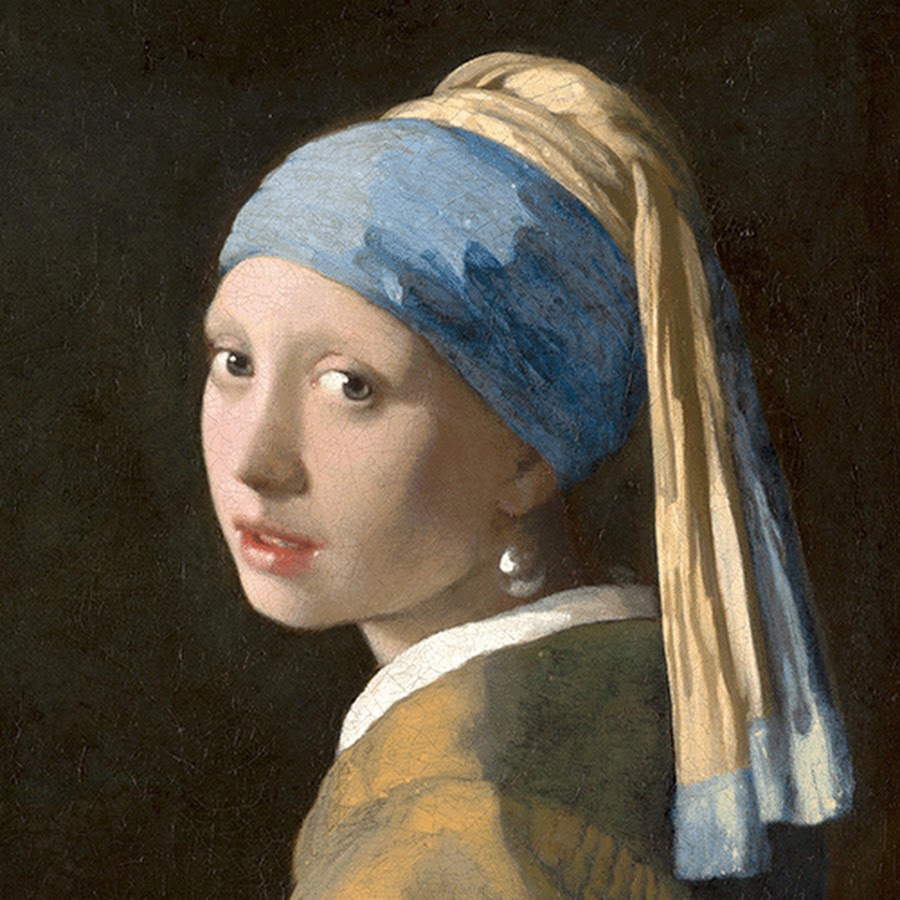
Girl with a Pearl Earring (c. 1665) by Johannes Vermeer; oil on canvas; 44.5 cm × 39.0 cm (17.5 in × 15.4 in); Mauritshuis; The Hague, Netherlands
Gazing into the wide, illuminated eyes of this young woman, you are instantly drawn into what appears to be an intensely intimate portrait. The striking contrast of her ultramarine and yellow turban against the pitch-black background pushes her face directly into your space, while an impossibly large pearl sharply catches the light. Because of this captivating immediacy, you might logically assume Johannes Vermeer was painting a specific, wealthy patron or a beloved family member.
But then you discover that this is not a portrait at all. In 17th-century Dutch art, this specific type of painting was known as a "tronie". This is a character study meant to depict an idealized expression or an exotic costume rather than a recognizable individual. Therefore, the girl’s true identity was entirely irrelevant to the original buyers.
The deception goes even deeper. The defining jewel of the painting is highly unlikely to be natural. The earring is far too large and perfectly reflective to be a genuine pearl from the 1660s. As a result, experts conclude Vermeer painted a teardrop-shaped glass bauble or polished tin, relying entirely on his absolute mastery of light. He used just two precise strokes of lead white paint to create the heavy, luminous reflection.
By deliberately stripping away any specific narrative, background, or identifiable identity, Vermeer created a timeless enigma. This careful ambiguity is precisely what allows you to project your own stories onto her fleeting backward glance today, cementing the work as an undisputed masterpiece of the Dutch Golden Age.
3 days ago | [YT] | 21
View 0 replies
why it's art
A deadly spectacle can freeze a crowd in absolute silence. When you examine this painting, you are looking at a sun-baked gathering in Algeria, where onlookers watch a gripping performance. In the center, a charmer is deeply focused on the snake coiled before him, capturing the rapt attention of both the adults and children watching from the shadows.
During the late 19th century, European audiences were obsessed with "Orientalism" (highly romanticized, exotic visions of North Africa and the Middle East). However, most French painters fabricated these scenes entirely from within their comfortable Parisian studios, using imported props and hired models. But then, a young artist originally named Alphonse-Étienne Dinet took a radically different path. He traveled to North Africa and became so enchanted by the culture that he refused to remain just an observer. Therefore, he learned fluent Arabic, embedded himself in the local community, and eventually converted to Islam, adopting the name Nasreddine.
Because he actively lived among the people he depicted, Dinet completely discarded the artificial stereotypes favored by his European contemporaries. As a result, "The Snake Charmer", painted in the oasis of Laghouat in 1889, vibrates with a striking realism. He meticulously documented the beautiful details of local clothing and the authentic daily life of Bedouin culture. This not a staged colonial fantasy. You are witnessing a genuinely recorded moment, captured by a French artist who fully integrated into the world he painted.
Nasreddine Dinet; The Snake Charmer; 1889; oil on canvas; 176.5 cm × 180.4 cm (69.5 in × 71.0 in); Art Gallery of New South Wales; Sydney, Australia
6 days ago | [YT] | 12
View 1 reply
why it's art
Tension can be so thick in a room that it practically suffocates you. When you examine Edgar Degas’s "Interior", you are immediately pulled into a deeply uncomfortable, intensely private standoff. On the right, a man leans casually against the door frame, his face hidden in the shadows, effectively blocking the only exit. Across the dimly lit room, a young woman sits hunched over in her chemise, her posture radiating exhaustion or despair. The physical space between them is littered with ominous clues: an open corset discarded on the floor, an open sewing box, and a single burning lamp casting harsh, theatrical shadows against a narrow bed.
Degas is most famous for painting delicate ballerinas in airy rehearsal rooms or wealthy patrons socializing at the racetrack. But then, between 1868 and 1869, he created this claustrophobic psychological thriller that completely abandoned his usual lighthearted subjects. During this period, the French art world was heavily influenced by the gritty, unvarnished realism of Naturalist literature. Art historians strongly suspect this canvas directly illustrates a scene from Émile Zola’s scandalous novel "Thérèse Raquin," where two lovers are trapped in a room, paralyzed by guilt after committing a murder.
However, Degas never explicitly confirmed the literary connection. Because the exact narrative remains intentionally unresolved, you are forced to become a witness to an ambiguous tragedy. He deliberately manipulated the harsh lighting and the vast spatial distance between the two figures to amplify a sense of dread and inescapable isolation. Therefore, instead of a simple domestic scene, the painting functions as an eerie snapshot of a fractured relationship or a menacing confrontation. As a result, "Interior" - which was controversially nicknamed "The Rape" by the artist's contemporaries - endures as one of Degas's most haunting and uncharacteristically dark masterpieces.
Edgar Degas; Interior; 1868–1869; oil on canvas; 81.3 cm × 114.3 cm (32.0 in × 45.0 in); Philadelphia Museum of Art; Philadelphia, USA
6 days ago | [YT] | 6
View 1 reply
why it's art
History is rarely as clean and flawlessly choreographed as 19th-century painters wanted you to believe. When you look at Dióscoro Puebla’s "The First Landing of Christopher Columbus in America", you immediately notice the absolute theatricality of the moment. Instead of depicting exhausted, desperate sailors staggering onto an unknown beach after a grueling voyage, the canvas presents a perfectly orchestrated triumph. Columbus stands center stage, dramatically gazing toward the heavens while grasping the Spanish royal standard and a drawn sword. Around him, his crew falls to their knees in sheer gratitude, while the Indigenous people of Guanahani cautiously observe the strange arrivals from the shadows of the dense foliage.
Puebla painted this colossal canvas in Rome in 1862. During the mid-19th century, Spain was grappling with its rapidly declining global influence, having already lost the vast majority of its American colonies. Therefore, the Spanish art establishment heavily sponsored grand historical paintings designed to remind the public of the nation's former imperial glory. They did not want gritty realism or complex historical nuance; they needed a heroic, myth-building spectacle.
Because Puebla flawlessly delivered this romanticized, highly nationalistic vision of the 1492 landing, the artwork was an immediate critical success, winning a prestigious first-class medal at the National Exhibition of Fine Arts in Madrid. As a result, this single painting helped heavily define the idealized visual mythology of the European arrival in the Americas - a commanding, culturally biased narrative that persisted in textbooks and public memory for over a century.
Dióscoro Puebla; The First Landing of Christopher Columbus in America; 1862; oil on canvas; 330 cm × 545 cm (129.9 in × 214.6 in); Museo del Prado; Madrid, Spain
1 week ago | [YT] | 0
View 0 replies
why it's art
A distant rider on a misty road is all it takes to make the immediate world fade away. When you examine Jennie Augusta Brownscombe’s "Love’s Young Dream", you immediately witness this familiar moment of youthful distraction. On the steps of a modest rural home, a young woman stands perfectly still, gazing longingly toward a man approaching on horseback. Beside her, an older woman (likely her mother) looks up from her knitting with a knowing expression of fondness and concern, while a male relative remains thoroughly engrossed in his reading, completely oblivious to the quiet drama unfolding.
Brownscombe strategically clustered all the human activity on the right side of the canvas. Therefore, your eye is naturally drawn outward toward the left, where an unencumbered view of a mist-shrouded landscape stretches into the distance.
Brownscombe painted this scene in 1887, during a period when the United States was rapidly industrializing. Late Victorian audiences were increasingly anxious about the chaotic social changes brought on by booming cities and modern factories. But then, Brownscombe tapped into a powerful cultural yearning for simpler times by championing the Colonial Revival movement. She deliberately constructed highly idealized, meticulously realistic visions of traditional rural life and early American history.
Because her work offered a comforting, moral escape from the relentless pace of the late 19th century, her images were heavily reproduced as prints and eagerly consumed by the public. She carefully engineered a reassuring narrative of domestic tranquility and enduring family values. As a result, "Love’s Young Dream" resonated deeply across both America and Europe, helping solidify Brownscombe’s position as one of the most commercially successful and highly regarded female artists of her generation.
Jennie Augusta Brownscombe; Love's Young Dream; 1887; oil on canvas; 54.0 cm × 81.6 cm (21.3 in × 32.1 in); National Museum of Women in the Arts; Washington, D.C., USA
1 week ago | [YT] | 0
View 1 reply
why it's art
Power and wealth usually dictate who sits on the throne. When you look at Edward Burne-Jones’s "King Cophetua and the Beggar Maid", you see a complete reversal of the traditional social order. A monarch in gleaming dark armor has cast aside his elaborate crown, choosing to sit on the lower steps of his own dais. He gazes upward with absolute devotion at a barefoot young woman in a plain, threadbare dress, who occupies the elevated seat usually reserved for royalty.
The painting illustrates an ancient legend of a king who famously despised women and refused to marry. But then, he glimpsed a destitute beggar maid from his window and was struck by a love so profound that he vowed to make her his queen.
During the late 19th century, Victorian Britain was driven by relentless industrialization and a rigid, wealth-based class system. Burne-Jones, a leading figure of the Pre-Raphaelite movement, deeply opposed this modern materialism. Therefore, he utilized this romantic folklore as a deliberate social critique. By meticulously rendering the rich, opulent textures of the court against the stark, ash-grey simplicity of the maid, he visually declared that pure love and spiritual beauty outrank earthly riches.
Because this monumental canvas perfectly captured a cultural yearning for a more chivalric, moral ideal, it caused an immediate sensation when exhibited in 1884. As a result, the artwork firmly established Burne-Jones’s reputation on an international scale, eventually winning a gold medal at the 1889 Paris Exposition Universelle and cementing the enduring appeal of the Pre-Raphaelite aesthetic.
Edward Burne-Jones; King Cophetua and the Beggar Maid; 1884; oil on canvas; 293.4 cm × 135.9 cm (115.5 in × 53.5 in); Tate Britain; London, United Kingdom
1 week ago | [YT] | 1
View 0 replies
why it's art
Legendary strength offers no protection when you are stripped of your vision and betrayed by those you love. When you look at Carl Bloch's "Samson and the Philistines", you immediately face the suffocating weight of total humiliation. In the center of a dark, oppressive mill, the biblical hero pushes an immense grinding wheel. His heavily muscled frame still hints at his former power, but his hollowed, bloodied eye sockets and cropped hair reveal his complete defeat. Around him, his captors jeer and brandish whips in the shadows, thoroughly relishing the destruction of their greatest enemy.
The story of Samson is typically remembered for his triumphant victories or his dramatic final revenge. But then, a twenty-nine-year-old Carl Bloch chose to paint the agonizing chapter in between. According to the Old Testament, Samson’s supernatural strength was a divine gift tied to his uncut hair. After being betrayed by Delilah, he was captured, shorn, and violently blinded. Therefore, Bloch deliberately bypassed the action-packed narrative climax to focus on the psychological devastation of a fallen titan.
Bloch painted this monumental canvas in Rome in 1863, deeply influenced by the dramatic, high-contrast lighting of the Italian Baroque masters. By plunging the background into darkness and fiercely illuminating Samson's strained physique, he amplifies the sheer physical exhaustion of endless, grinding labor. You are observing a religious myth but also you are forced to witness a profoundly human tragedy of vulnerability. Because Bloch perfectly balanced this grueling emotional realism with flawless academic execution, the artwork created an immediate sensation. As a result, this single painting firmly established his reputation back home, transforming him from a promising young student into one of Denmark's most celebrated masters.
Carl Bloch; Samson and the Philistines; 1863; oil on canvas; 245.5 cm × 184 cm (96.7 in × 72.4 in); Statens Museum for Kunst; Copenhagen, Denmark
1 week ago | [YT] | 0
View 0 replies
why it's art
This woman was casually peeling potatoes when a single piece of paper shatters her entire world. When you look at Berthold Woltze's "The Letter", you immediately witness the crushing weight of sudden tragedy. A young, visibly impoverished mother leans heavily against a massive stone hearth, her face frozen in absolute despair. A half-peeled potato rests in her apron, while others have tumbled to the floor alongside a hastily discarded envelope. Beside her, a young daughter clutches her arm, looking up in anxious confusion.
Woltze built his career in the late 19th century as a highly successful German genre painter, typically known for capturing the straightforward, everyday lives of ordinary citizens. But then, he tapped into a rising artistic trend known as the "problem picture." In this style, artists intentionally stripped away crucial context to create a compelling visual puzzle. Therefore, instead of passively viewing the artwork, you are forced to become a psychological detective. Woltze deliberately hides the exact contents of the tragic letter. Has her husband been killed in an accident, or has he abandoned his family to poverty? Because of this intentional ambiguity, such paintings sparked endless debate among contemporary audiences. As a result, the artwork transforms from a simple domestic scene into a highly interactive drama. You do not need to read the words on the page; her badly worn shoes and the sheer physical collapse of her posture tell you everything about the devastating reality she now faces.
Berthold Woltze; The Letter; 1896; oil on canvas; 72.5 cm × 57.5 cm (28.5 in × 22.6 in); Private Collection; Unknown Place
1 week ago | [YT] | 0
View 0 replies
why it's art
In this prestigious professional portrait the central focus of the canvas is a recently executed criminal. When you examine "Anatomy lesson by Dr. Nicolaes Tulp" by Rembrandt van Rijn, you see seven men in formal dark clothing and white ruffs leaning intensely over a pale, brightly illuminated cadaver. On the right, Dr. Tulp, distinguished by his dark hat, uses forceps to pull back the skin and expose the complex musculature of the arm while the observers stare with rapt attention. In the lower right corner, a massive open anatomical text grounds the scientific demonstration.
In 1632, the Amsterdam Guild of Surgeons commissioned this painting to document their annual public dissection. Traditionally, Dutch group portraits were stiff, predictable affairs where subjects lined up in uniform rows, each paying equally for their share of the canvas. But then, a twenty-six-year-old Rembrandt van Rijn took the assignment and completely dismantled the standard format. He injected a powerful psychological narrative into the scene. Therefore, instead of a static lineup, you witness a dynamic, carefully engineered moment of intellectual discovery.
Public dissections were rare, theatrical spectacles permitted only once a year during the freezing winter months to slow decomposition. The subject on the table was Aris Kindt, an armed robber hanged earlier that very day. Dr. Tulp is shown demonstrating the mechanics of the flexor muscles, a specific choice reflecting the 17th-century belief that the mechanical perfection of the human hand proved the existence of a divine creator. Because Rembrandt masterfully balanced this profound scientific narrative with the individual likenesses of his patrons, the commission catapulted him to overnight fame. As a result, this single canvas forever redefined the possibilities of group portraiture during the Dutch Golden Age.
Rembrandt van Rijn; The Anatomy Lesson of Dr. Nicolaes Tulp; 1632; oil on canvas; 169.5 cm × 216.5 cm (66.7 in × 85.2 in); Mauritshuis; The Hague, Netherlands
1 week ago | [YT] | 0
View 0 replies
why it's art
Step into the oppressive darkness of an ancient tragedy. When your eyes adjust to the low light of this canvas, you see a powerful ruler sitting motionless, cradling the lifeless body of his young heir. Beside him, a grieving mother collapses against the pharaoh in despair, while surrounding musicians and courtiers in the shadows sit in a stunned, agonizing silence.
Lawrence Alma-Tadema built his immense reputation by painting sun-drenched marble, sparkling Mediterranean shores, and the carefree decadence of antiquity. You usually expect bright, meticulously researched archaeological details from his work. But then, with this 1872 masterpiece, he takes a dramatically unexpected turn. He strips away the brilliant sunlight entirely and plunges you into a claustrophobic, candlelit gloom.
This stark shift in atmosphere serves a very specific narrative purpose. The painting captures the horrific climax of the Ten Plagues of Egypt from the Book of Exodus - the striking down of the firstborn. Therefore, Alma-Tadema required a visual language that felt heavy and inescapable. By subduing his famous color palette and hiding the architectural grandeur in shadows, he amplifies the sheer psychological weight of a god-king realizing his earthly supremacy is utterly useless against divine retribution.
Victorian society possessed an insatiable appetite for Egyptology, largely driven by continuous archaeological breakthroughs of the era. As a result, artists frequently capitalized on this fascination by painting grand, sweeping historical spectacles. However, Alma-Tadema bypasses the predictable monumental scale to force you into a suffocating, intimate confrontation with the quiet collapse of a dynasty.
Lawrence Alma-Tadema; The Death of the Pharaoh’s Firstborn Son; 1872; oil on canvas; 77 cm × 124.5 cm (30.3 in × 49.0 in); Rijksmuseum; Amsterdam, Netherlands
1 week ago | [YT] | 0
View 0 replies
Load more