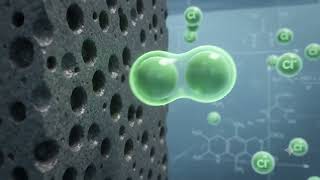
Sodium hypochlorite NaOCl production
KR4DYC-John Thomas Winskas |
10 videos |
Updated 2 months ago
share.gemini.google/AmwBB4jo5rsP
can you make bleach from sodium chloride?
Household bleach (sodium hypochlorite, NaOCl) is produced from sodium chloride (NaCl) and water via electrolysis, a process widely known as electrochlorination.
Water Europe Marketplace
Chemical Mechanism
When direct electric current (DC) passes through a brine solution in an undivided electrolytic cell, several reactions occur simultaneously:
MDPI
Anode Reaction (Oxidation): Chloride ions lose electrons to form dissolved chlorine gas.
Water Europe Marketplace
2Cl
−
→Cl
2
+2e
−
Cathode Reaction (Reduction): Water molecules gain electrons, generating hydrogen gas and hydroxide ions.
Water Europe Marketplace
2H
2
O+2e
−
→H
2
↑+2OH
−
Solution Reaction (Disproportionation): Because the cell lacks a separating membrane, the dissolved chlorine reacts directly with the sodium hydroxide (NaOH) formed in solution:
PMC - NIH
Cl
2
+2OH
−
→OCl
−
+Cl
−
+H
2
O
Overall Net Reaction:
NaCl+H
2
O+electricity→NaOCl+H
2
↑
Key Operational Factors
Temperature Control: The solution must be kept cool (typically below 40°C / 104°F). At higher temperatures, hypochlorite oxidizes further into unwanted sodium chlorate (NaClO
3
):
Google Patents
3OCl
−
Δ
ClO
3
−
+2Cl
−
Electrode Selection: Standard metal anodes (like copper or iron) dissolve rapidly due to chlorine corrosion. Mixed metal oxide (MMO), platinum-coated titanium, or dimensionally stable anodes (DSA) are required.
Gas Hazards: The cathode releases flammable hydrogen gas (H
2
), and improper pH control can cause toxic chlorine gas (Cl
2
) to off-gas rather than stay dissolved in solution. Commercial systems use dedicated ventilation systems to disperse H
2
safely.
mp.watereurope.eu/d/technology/1228#:~:text=At%20t….