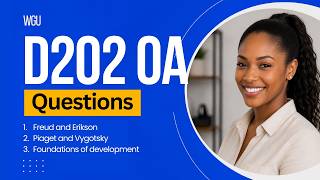
D202 OA — Fast-Track Crash Course
OA Practice |
3 videos |
Updated 2 months ago
Start Studying for Free Today:
📘 Study Guide & Course Breakdown: oapractice.com/d202
🧩 Free Practice Questions:
questions.oapractice.com/practice-questions/C/?ec=…
🧩 Free Timed Exams:
onlineexamtest.com/exam_sets/human-growth-and-deve…
📬 Want a Guaranteed Pass? Connect with our premium tutors today:
oapractice.com/contact
Preparing for the WGU D202 Lifespan Development OA? These questions and answers covers the full course from foundations to theory. Whether you are working toward a career as a teacher, a counselor, a social worker, or a nurse caring for patients of every age across the United States, understanding how people grow and change across the lifespan is knowledge you will use in almost any human services career. This video walks you through real exam style questions and breaks down the theories the way they actually appear on your objective assessment, so you can walk into test day with confidence.
In this course, we cover the core D202 topics that show up most on the OA:
🔸 Foundations of development: the three domains of development, the ordered periods of the lifespan, growth patterns, and the big debates including nature versus nurture, continuous versus stage like change, and critical versus sensitive periods
🔸 Freud and Erikson: Freud's psychosexual stages and the id, ego, and superego, plus Erikson's eight psychosocial stages from trust versus mistrust through ego integrity versus despair
🔸 Piaget and Vygotsky: Piaget's four stages of cognitive development and assimilation versus accommodation, alongside Vygotsky's zone of proximal development and scaffolding
🔸 Learning, morality, genetics, and research: classical versus operant conditioning, Bandura's self efficacy, Kohlberg and Gilligan on moral development, Bronfenbrenner's ecological systems, the basics of genetics and inheritance, and cross sectional versus longitudinal research
Why does this matter? The D202 OA is scenario based. The exam does not just ask you to define a theory, it gives you a situation and asks which concept or stage fits. That is exactly how we teach in this video, using the signal words and traps WGU loves to test, like Piaget versus Vygotsky and classical versus operant conditioning. Strong knowledge of lifespan development also carries into your future career, whether you are teaching a classroom, counseling a family, or caring for patients at any stage of life in an American clinic, school, or hospital.
Study smarter, not longer. Pair this video with our free practice questions and timed exams above to lock in your knowledge before test day.
🔔 Don't forget to LIKE, SUBSCRIBE, and hit the bell so you never miss a new WGU OA study session. New videos drop every week to help you reach your goal!
Disclaimer: OA Practice is not affiliated with WGU or any certification providers. This content is created independently for educational purposes to help students prepare for their assessments.
#WGU #WGUD202 #LifespanDevelopment #WGUOA #DevelopmentalPsychology #OAPractice #WGUStudent #PsychologyDegree #ExamPrep #StudyGuide #PracticeQuestions #OnlineDegree #WGUExam #PassTheOA #PsychologyStudent #ErikErikson #Piaget #ChildDevelopment #NursingSchool #WGUNursing