
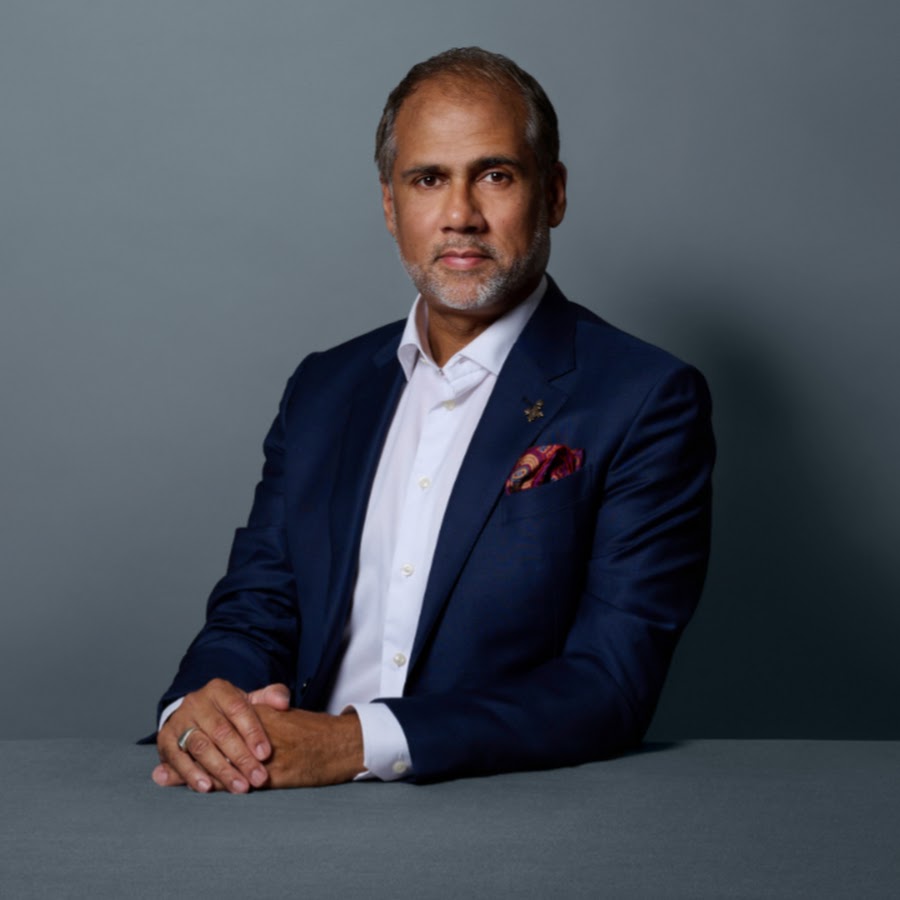
 Alpesh Patel OBE
Check out all my free resources at the link below!
As a Visiting Fellow at Oxford University, Hedge Fund Manager, International best-selling Financial Times Author, and former Bloomberg TV presenter, I am a leading authority in the realm of Investing and Entrepreneurship. Recognized as the "UK's best known online trader" by Channel 4 TV and a "Top FTSE 100 forecaster" by the Financial Times, my expertise lies in identifying successful companies and teaching others how to invest.
In 2020, I was awarded the OBE for my contributions to the economy and international trade.
Posts
Alpesh Patel OBE
Why Portfolios, Not Stocks, Decide Your Financial Future
When I show people the performance of my model portfolios, the first reaction is usually: “But which stock made the money?” It’s the wrong question. That’s like asking a Test cricket captain, “Which single player won you the match?”
The answer is: none. It was the batting order, the bowling attack, the field placement — the team.
Investing is no different.
Over the past few years, my model portfolios have outperformed the benchmarks not because of some magical stock tip, but because of disciplined portfolio construction: diversification, risk management, and weighting. Take one portfolio I run as an example — over four years it returned nearly 300% with far lower volatility than the market average. Another compounded at over 600% in five years.
Did I achieve this by chasing meme stocks or betting on the latest AI darling? No. The results came from a carefully designed system where losers were cut quickly, winners were allowed to run, and the portfolio was constantly balanced for risk.
Here’s the kicker. I did not know which stock would do the best, or indeed that some would sometimes fall, or which months or years would be stronger than others. I knew none of that. I don’t need to.
The obsession with the “one hot stock” is a colonial hangover. In the Raj, they told us to gamble on indigo or cotton, never to think of the bigger system of trade and value. But wealth is not built by lottery tickets. It is built by portfolios that can withstand wars, pandemics, and inflationary shocks — and still come out compounding.
Individual stocks are noise; portfolios are signal. A single share can halve overnight on a profit warning. But a robust portfolio will absorb the hit, because the other assets — carefully chosen for growth, value, and resilience — are there to carry the weight. This is why the wealthy do not buy “stocks.” They buy portfolios.
For British Indians in particular, the lesson is vital. Too many still treat investing like a weekend flutter at the bookies, looking for the one stock to double by Diwali. That mentality is why pensions underperform and portfolios stagnate.
The serious investor asks: “What structure of holdings will protect my downside and compound my upside?”
So, the next time someone asks me which stock I’m buying, my answer is simple: I’m not buying a stock, I’m building a portfolio. That is how wealth is created — not by picking winners, but by being a portfolio manager of your own future.
If you want financial independence, stop acting like a punter and start acting like a portfolio manager. After all, no one remembers who hit a six in the 23rd over. They remember who lifted the trophy.
Alpesh B Patel
4 months ago | [YT] | 2
View 0 replies
Alpesh Patel OBE
Why Fund Managers Can't Be Trusted with Your Pension
Entrusting pension funds to professional fund managers is a widespread practice, underpinned by the assumption of expertise, fiduciary responsibility, and financial prudence.
However, repeated instances of underperformance, high fees, lack of transparency, and misaligned incentives have cast doubt upon their reliability.
This essay critically examines the reasons why fund managers often fail to serve pension investors' best interests, focusing on systemic inefficiencies, incentive misalignment, and evidence of suboptimal performance.
Systemic Inefficiencies and Poor Performance
Despite widespread claims of professional expertise, empirical evidence consistently highlights fund managers' inability to outperform basic market indices.
According to the S&P Indices Versus Active (SPIVA) report, over 80% of actively managed funds consistently underperform their benchmarks over 10-year periods.
Over 80% of UK active fund managers underperformed their benchmarks over a 10-year period (Source: SPIVA 2023)
Over 80% of UK active fund managers underperformed their benchmarks over a 10-year period (Source: SPIVA 2023)
These results question the notion that active management provides superior outcomes compared to passive investment strategies.
The inherent inefficiencies within the active fund management sector are exacerbated by excessive trading, which not only generates significant transaction costs but also reduces net returns.
Barber and Odean (2000) highlight how excessive trading can erode investors' capital, demonstrating that high turnover rates correlate negatively with returns.
Consequently, the frequent buying and selling executed by fund managers often erodes potential gains rather than enhancing them.
Misaligned Incentives
Fund managers' remuneration structures commonly involve significant fees based on assets under management rather than performance. Such fee structures incentivise asset gathering rather than the maximisation of client returns.
Consequently, fund managers often prioritise marketing, sales tactics, and asset accumulation over effective investment management. Research by French (2008) and Bogle (2005) underscores how high fees associated with active management directly reduce investors' net returns, undermining pension growth.
Additionally, the principal-agent problem, as described by Jensen and Meckling (1976), manifests clearly within the pension fund industry. Fund managers acting as agents often pursue their interests—securing management fees—at the expense of pension holders' long-term financial goals.
The divergence between managers' short-term performance targets and investors' long-term retirement objectives creates an environment where fiduciary responsibilities can easily be overlooked.
Over 30 years, a 2% annual fee can drastically reduce pension wealth compared to a 0.2% passive fund
Lack of Transparency and Accountability
Transparency remains alarmingly inadequate within the fund management industry. Investors often find it challenging to obtain detailed information about the actual composition of their investment portfolios or to clearly understand the rationale behind particular investment decisions. This opacity impairs investors' ability to hold fund managers accountable, allowing underperformance to persist unchecked.
The complexity and obfuscation of investment strategies further compound this issue. Terms such as “active blended solutions” and “strategic asset allocations” often mask poor decision-making and underperformance.
Such deliberate opacity, as highlighted by Kahneman (2011), exploits investors' cognitive biases and information asymmetry, reducing their capacity to make informed choices about pension management.
Practical Alternatives: Empowering Pension Investors
In light of these shortcomings, passive investment strategies such as low-cost index tracking funds or Exchange Traded Funds (ETFs) offer viable alternatives. Empirical research supports the superiority of passive management regarding net returns, lower costs, and increased transparency.
Passive pension strategies like index funds historically outperform active funds over the long term
Pension investors can thus significantly improve their retirement outcomes by adopting a more self-directed or passively managed approach, diminishing reliance on fund managers whose interests often misalign with their own.
The behavioural difference between active and passive investors can be dramatic — particularly during volatile markets.
Conclusion
Fund managers' consistent underperformance, systemic inefficiencies, misaligned incentives, and lack of transparency strongly indicate they cannot reliably be trusted to manage pensions.
Rather than delegating pension savings to fund managers incentivised primarily by asset accumulation, pension investors should adopt passive investment strategies characterised by low fees, transparency, and aligned incentives.
Only by critically reassessing reliance on traditional fund management can pension investors safeguard their long-term financial interests.
References
Barber, B. M., & Odean, T. (2000). Trading is Hazardous to Your Wealth: The Common Stock Investment Performance of Individual Investors. Journal of Finance, 55(2), 773-806.
Bogle, J. C. (2005). The Battle for the Soul of Capitalism. Yale University Press.
French, K. R. (2008). The Cost of Active Investing. Journal of Finance, 63(4), 1537-1573.
Jensen, M. C., & Meckling, W. H. (1976). Theory of the Firm: Managerial Behavior, Agency Costs and Ownership Structure. Journal of Financial Economics, 3(4), 305-360.
Kahneman, D. (2011). Thinking, Fast and Slow. Penguin Books.
S&P Dow Jones Indices. (2023). SPIVA® U.S. Scorecard.
Disclaimer: Past performance is not indicative of future results. Investments can fall as well as rise, and you may get back less than the original amount invested.
4 months ago | [YT] | 3
View 0 replies
Alpesh Patel OBE
Amazing fun sharing my life's work and research.
6 months ago | [YT] | 1
View 0 replies
Alpesh Patel OBE
Hi,
Forgive my anger, but I am fed up with fund managers and IFAs underperforming on people's pensions, savings and futures.
Why isn't your portfolio up 60% in the past year? Your SIPP/ISA/401(k)?
My next webinar is "Top Investments Now with US Market All Time Highs - Buy the Dip? Sell the Rally? Where Are the 100% Returns this Year?"
SignUp: www,alpeshpatel.com/smartinvest
I will cover why your pension pot is underperforming and exactly what you need to do about it. Our goal: 40% in 2021 overall - medium risk.
Don’t miss this at this critical time. It’s the only webinar you need for 2021, from the only FCA regulated hedge fund manager who used to be a private investor like you – so can really truthfully show the way to do it right for profit.
See you on the webinar,
Alpesh
Our webinars are educational and NOT individual tailored investment advice. All investing and trading is risky.
Sincerely,
Alpesh Patel OBE
Hedge Fund Founder, CEO Praefinium
Financial Times Author
Former Visiting Fellow in Business, Corpus Christi College, Oxford University
4 years ago | [YT] | 8
View 0 replies
Alpesh Patel OBE
A major problem our campaign solves on www.campaignforamillion.com with its free tools and resources for investors.
4 years ago | [YT] | 3
View 0 replies
Alpesh Patel OBE
Many people asking me about this today. I've done a detailed analysis.
4 years ago | [YT] | 3
View 0 replies
Alpesh Patel OBE
My best trading reads you will want to check out. Each book is entertaining and informative.
See my Podcast too: anchor.fm/alpeshpatel/episodes/Pips-Predator-by-Al…
4 years ago | [YT] | 5
View 0 replies
Alpesh Patel OBE
I flew to Malibu from London - and this video shows why - to meet a US Presidential candidate and ask the most important question of our time. I've just uploaded it.
6 years ago | [YT] | 4
View 0 replies